


 "Intense artisan process sustained by forced relaxation" happens at Dreamworks, according to I Wish I Worked There, a look inside the most creative spaces in business, a book which (of course) has its own website and a blog that has not been updated for a while. And on the website there is a short and annoying promo, where happy creative staff are shown having fun in their innovative working environments, accompanied by what used to be called slogans but are now called messages: text which is playfully angled and tells us to "promote collaboration" and "encourage play." These are creative spaces, the inspiring workplaces of twenty famous brands, where innovation is at the heart of their culture.
Microkitchens are destinations that have been deliberately built into daily Google life. Each one has a different feel and is stocked with different food preferences, so people are encouraged to visit different spaces throughout their working week. The unwritten rule, that no Googler is ever more than 150 feet away from food, means that there is an abundance of opportunities to stop, refuel and casually connect with co-workers.
Or Johnson and Johnson, where sharing is working:
Bulldog clip placeholders allow for regular rearrangement of team members, to encourage mixing.Or Nike, where ideation maters:
Semi-private booths support telephone activity and private focus for media planners and marketers.
Designer teams share one big table, supporting the collaborative nature of their work.
Casual ideation pods are primed, ready for use.
A Filing cabinets form focused yet open ideation pods with pin-up space
B Natural light and wonderful views promote the right creative state
C Storage files on wheels and bins filled with supplies - everything you need for an ideas session
D Comfortable seating and low tables encourage relaxed ideas sharing
E Whiteboard tabletops for quick capture
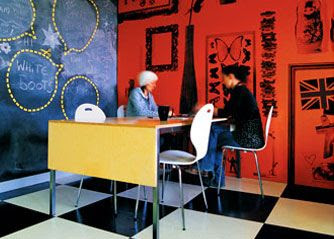
Or Urban Outfitters:
Perched on top of a decapitated hill in southern California, the headquarters of sunglasses manufacturer Oakley could be taken for a post-apocalyptic fortress from an alien planet. It is aptly described on Oakley's website as 'a place of reinforced blast walls and the padded cells of mad science.'
In the Urban Outfitters retail environment, people are taken on a journey that
draws them in, tickling their imagination and lulling them into a creative
state. This piques curiosity and implies constant movement rather than a finite
point of completion. The 'unfinished' nature of these spaces is a critical part
of the underlying creative philosophy... paint peeling from columns, untreated
sealed walls, partly sanded floorboards - it's all about continuing a journey,
not about having arrived.


Eleven Years ago I wrote this:
The Catholic Cathedral of the Blessed Sacrament, architecturally rated the finest of them for its originality, has lost its front. Designed by Wellington settler-draughtsman Frank Petrie in 1899, it won high praise from a visiting George Bernard Shaw in 1934.Close, but no basilica, Mr Roughan. In fact, The Cathedral of the Blessed Sacrament was designed by Dunedin architect Francis William Petre (Protip: pronounced 'peter') who was born and raised in New Zealand but educated and trained in England. Rather well-educated and well-trained, in fact; he was about as far from a draughtsman as one could be. Petre is interesting for so many reasons: the son of a relocated aristocratic English Catholic family who learned an awful lot about structure and concrete, applying his knowledge in numerous buildings. He designed an awful lot for the Catholics, Cargill's Castle for a member of his wife's Presbyterian family and he was known as "Lord Concrete."Somebody should write a book about him. I don't wish to knock Mr Roughan for making a mistake and nor am I being petty about Petre. Mr Roughan, after all, has written thus:Christchurch is a flat canvas and it has bred architects that have been probably the country's best. Warren and Mahoney, Peter Beaven. Warren and Mahoney's Town Hall auditorium is still the most stunning modern space I have experienced anywhere.Yes. Mr Roughan is sensitive to architecture and concerned about the future of Christchurch's past. But I am putting him right on this matter, not just because Petre was a fascinating architect but because he was an architect. New Zealanders seem to want to believe that our historic buildings


